Blog
Insights, updates, and deep dives into AI-powered project scheduling, construction planning, and optimization techniques.

How old is the news you act on?
Measure construction reporting and decision delay using site diaries, reports and minutes. Find where your project waits before making a decision.
AI Time-Location Charts from P6: Draw Me a Viaduct
See how an AI agent turns a P6 or OPC programme into a live time-location chart by finding and deriving its location data, without activity-by-activity setup.
Most Project Reports Are Written Backwards
How project-controls teams write a project report that drives the next decision instead of recording the month: start from the decision the reader must make, show the basis for every material claim, and use AI agents for the assembly work while your team keeps the judgment.
Your Project Needs a Knowledge Base
Ask a good colleague a question and you get the answer plus everything that makes it checkable. Ask an agent the same question and you get the answer on its own. That gap is not a retrieval problem, and more documents will not close it.
Auto Progress Updates, Done Right
P6's Update Progress copies a frozen shadow of the plan over your real actuals. That is why experienced planners are told never to touch it. Oracle's own fix, in Primavera Cloud, was to remove the button entirely. There is a correct way to auto-status a schedule, and it takes three rules.
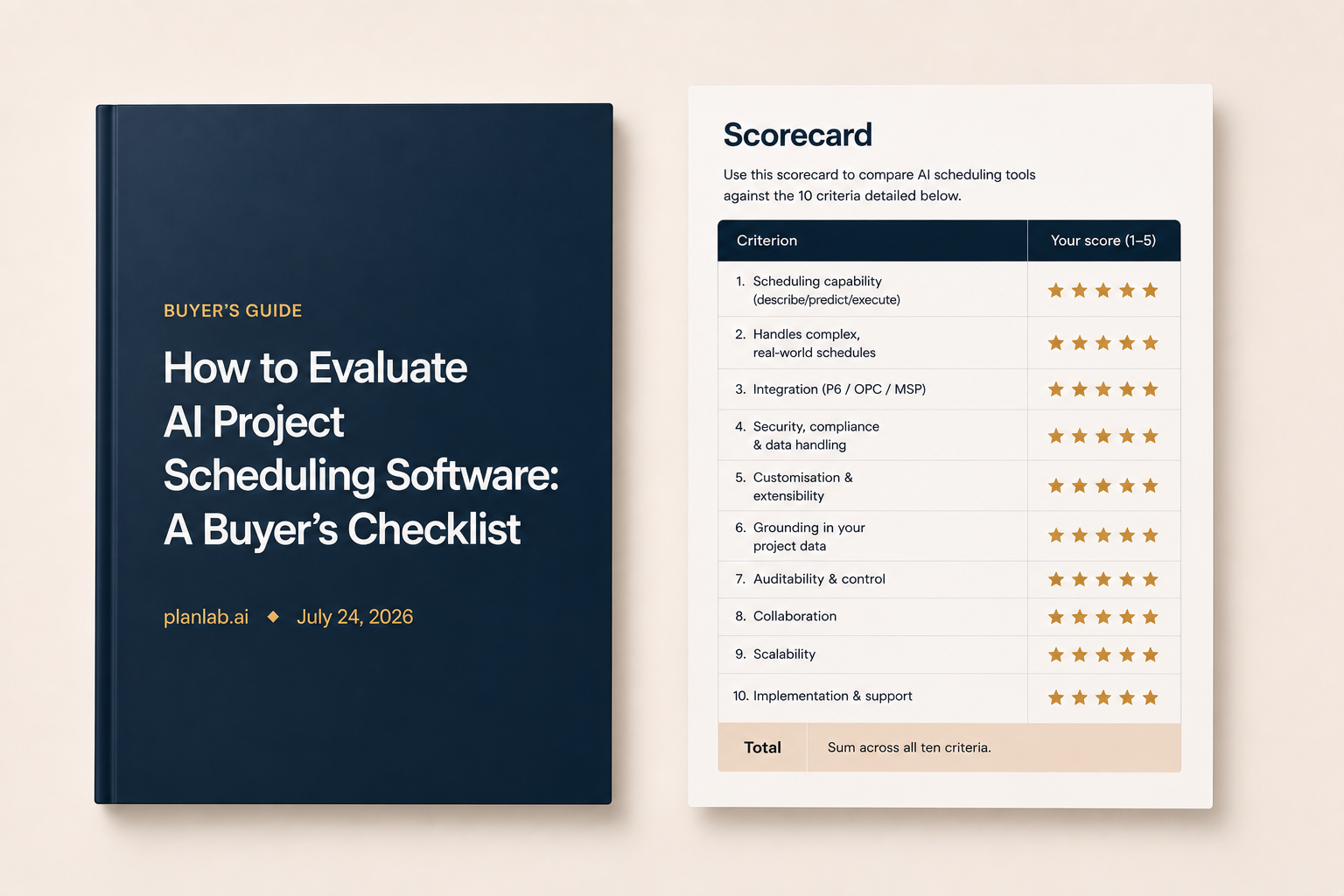
How to Evaluate AI Project Scheduling Software: A Buyer’s Checklist
This guide gives you a 10-point checklist to evaluate which AI scheduling software is right for you. The aim is to help separate a comprehensive platform with project controls capabilities from a reporting add-on with clever marketing.
Assurance Was Always a Capacity Problem
Projects rarely fail for surprising reasons. They fail for basic ones that should have been spotted months earlier. The reason they are not spotted is that nobody has the hours, and that is the constraint that has just been lifted.
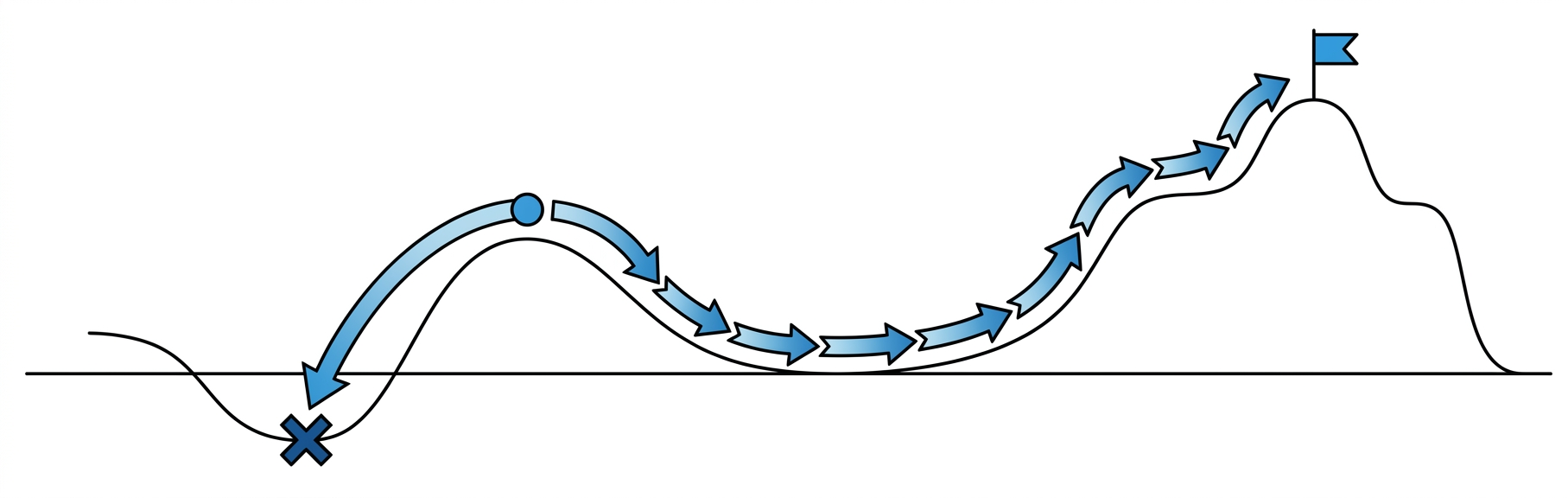
Resource leveling, searching the space of orderings
Most of the battle in optimization is won by searching a sensible space. We show how representing resource-constrained schedules as topological orderings makes the search for good solutions far more tractable.
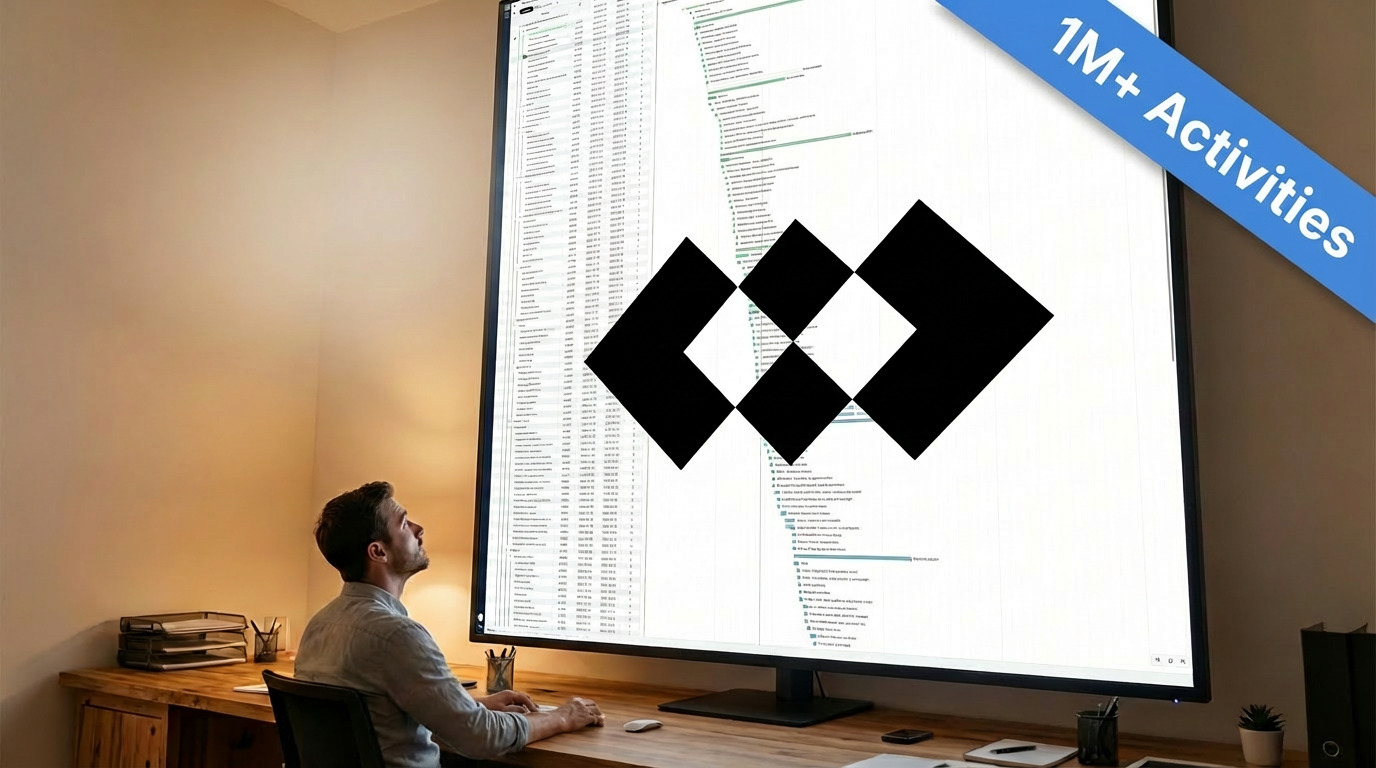
How I Learned to Stop Worrying and Open that XER with 1 Million Rows
Planlab upgrades the schedule editor to handle XERs with 1,000,000 rows. Here are the design decisions that made it possible.
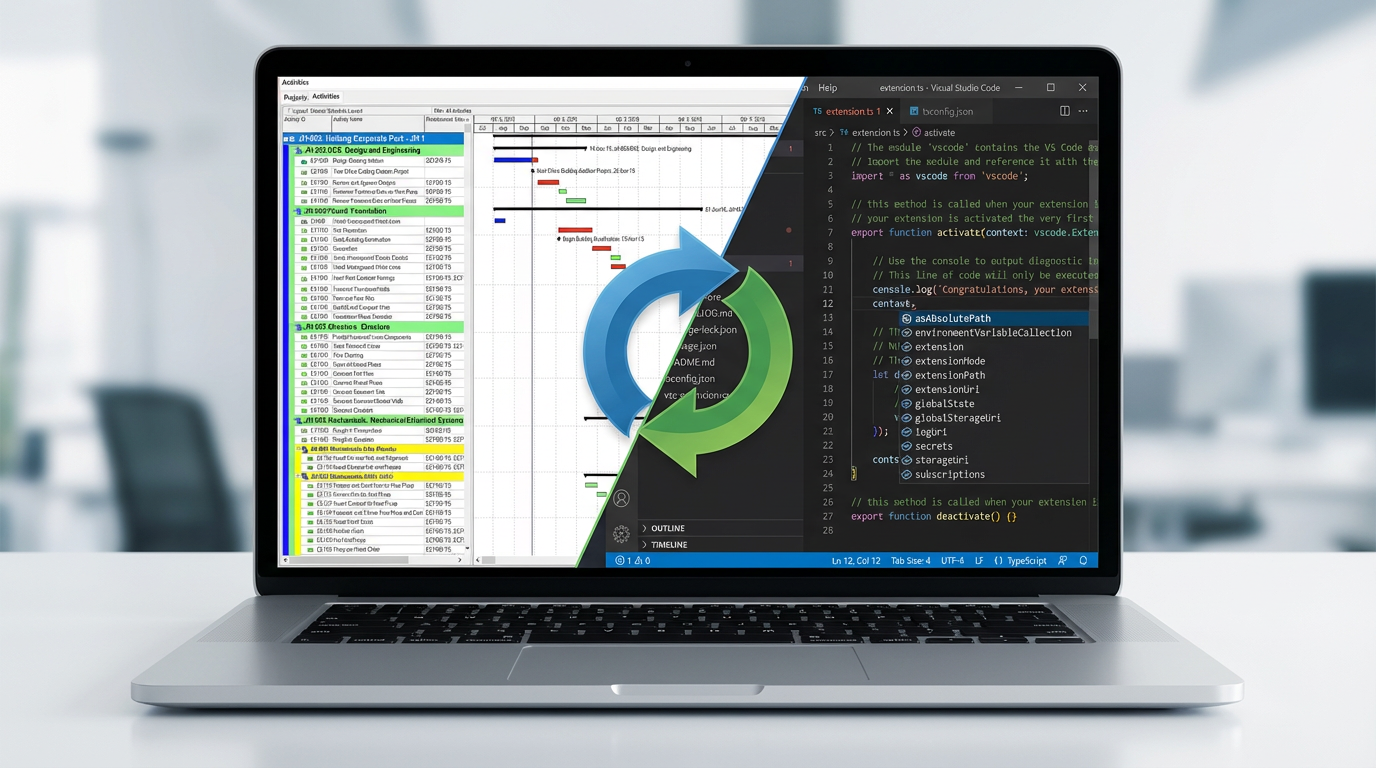
If Planners Were Programmers
After two years building Planlab, we've discovered a surprising truth: planning and programming are nearly identical disciplines. Here's what happens when you give planners access to a programmer.
Data is Your Future Competitive Advantage
Competitive advantage in construction has evolved from capital to expertise. The next shift? Data. Here's why you need to guard it carefully, and how we help you do that.
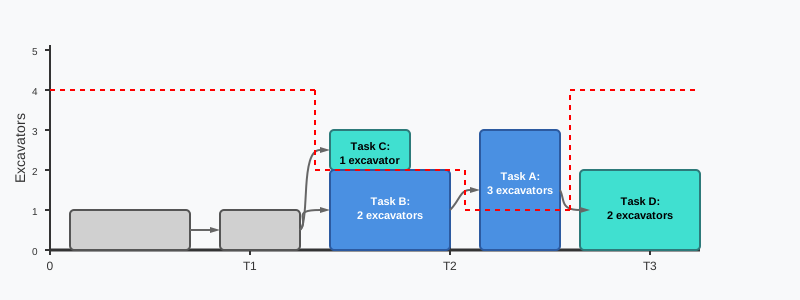
Resource leveling, a graph theory approach
An introduction to resource leveling in project scheduling using graph theory. Learn how the AIRL algorithm helps find optimal task orderings that satisfy resource constraints while minimizing project duration.

Challenge 3: Health and Safety
A scheduling challenge focused on health and safety constraints in motorway overpass renovation. Navigate complex H&S rules, resource-loaded LOEs, and optional hydrodem constraints to find the optimal schedule.
Modelling un-interruptible activities
A practical guide to modelling activities that cannot be interrupted during shutdown periods, such as summer holidays. Learn how to use shadow calendars and milestones to enforce these constraints in P6 and other scheduling software.

Challenge 2: Adding Real-World Complexity
A scheduling challenge that builds on our first competition, introducing overhead costs, benefits, resource mobilisation, and idle time. Plus our solution achieving £36M net value using AIRL optimization.

Challenge 1: Value-Based Scheduling
Our first scheduling competition: optimise a mining facility schedule by balancing duration, resource mobilisation, and activity acceleration. Plus our £107.5M solution using automated search.
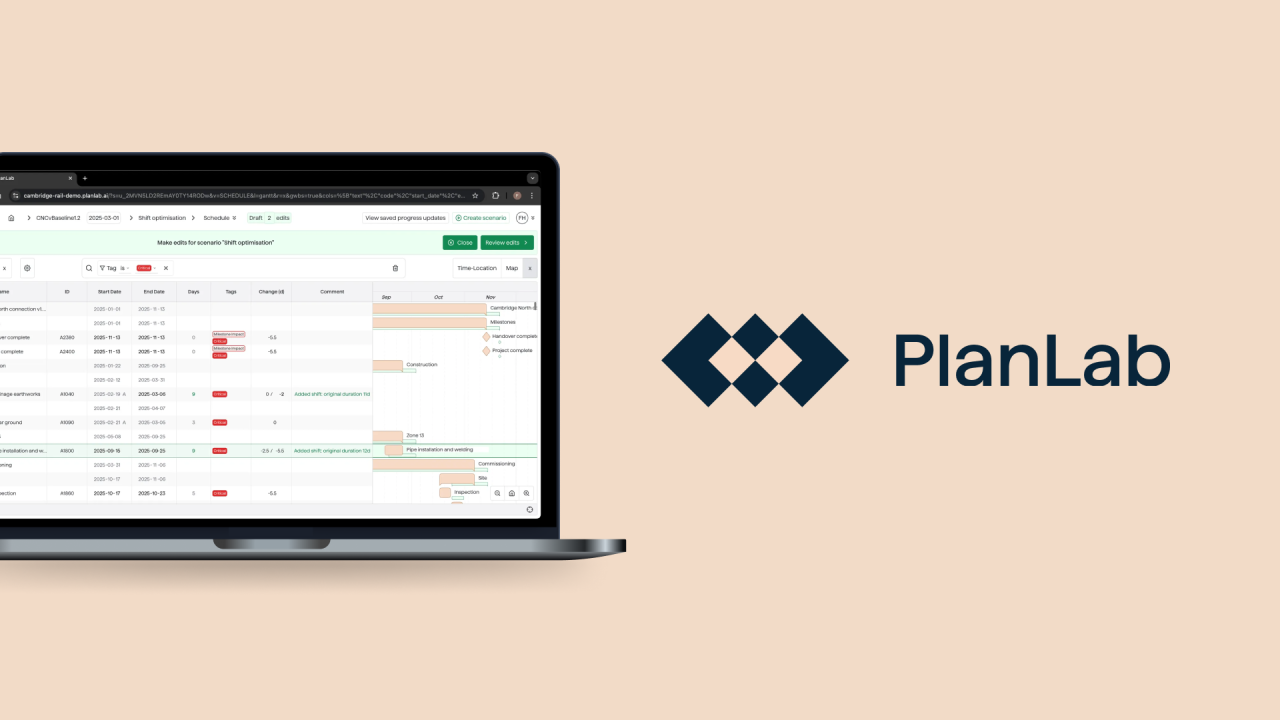
Accelerate Your Schedule with Additional Shifts
Need to catch up a delay? Adding shifts to critical activities can be effective, but which activities do you target? We explore the forward-pass and backward-pass approach, and how to automate it.
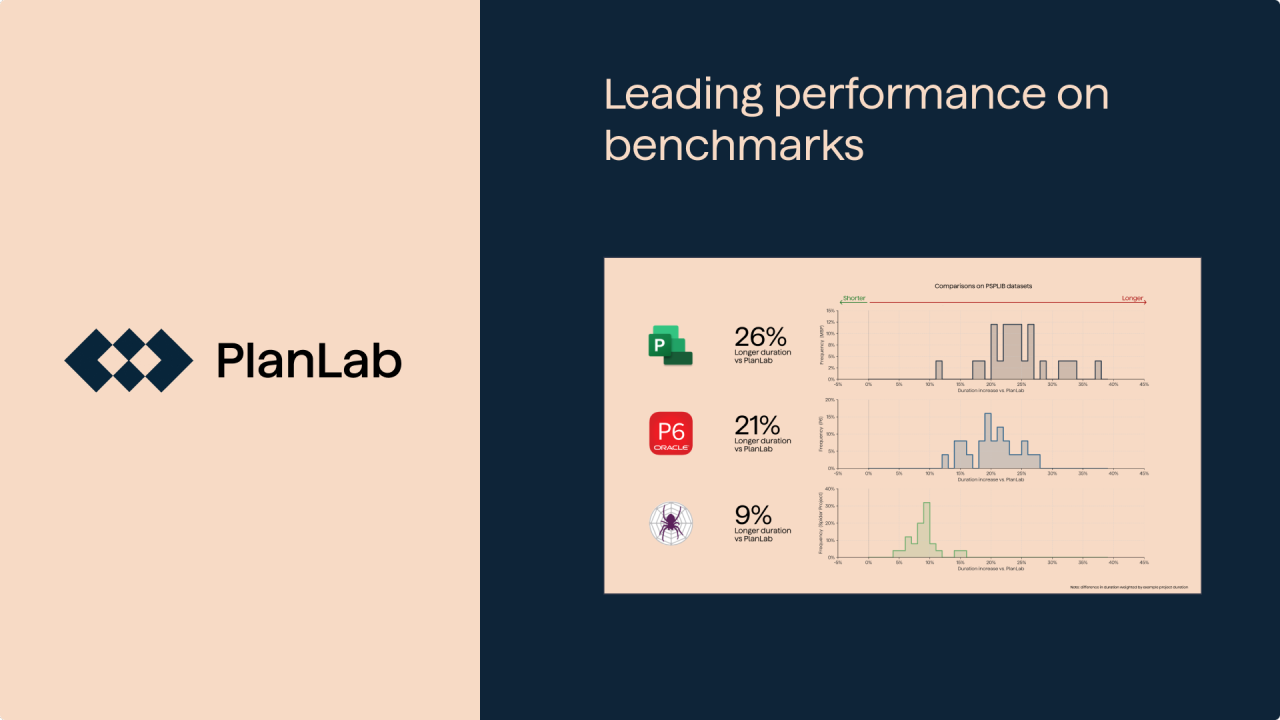
Planlab Beats Competitors on Resource Scheduling Benchmarks
We benchmarked our optimizer against Oracle P6, Microsoft Project, and Spider Project using independent test data. The results speak for themselves.
Understanding Critical Paths with Multiple Calendars
When tasks along the critical path use different calendars, changes in task duration can have unexpected effects on project duration. Learn how to analyze these scenarios.
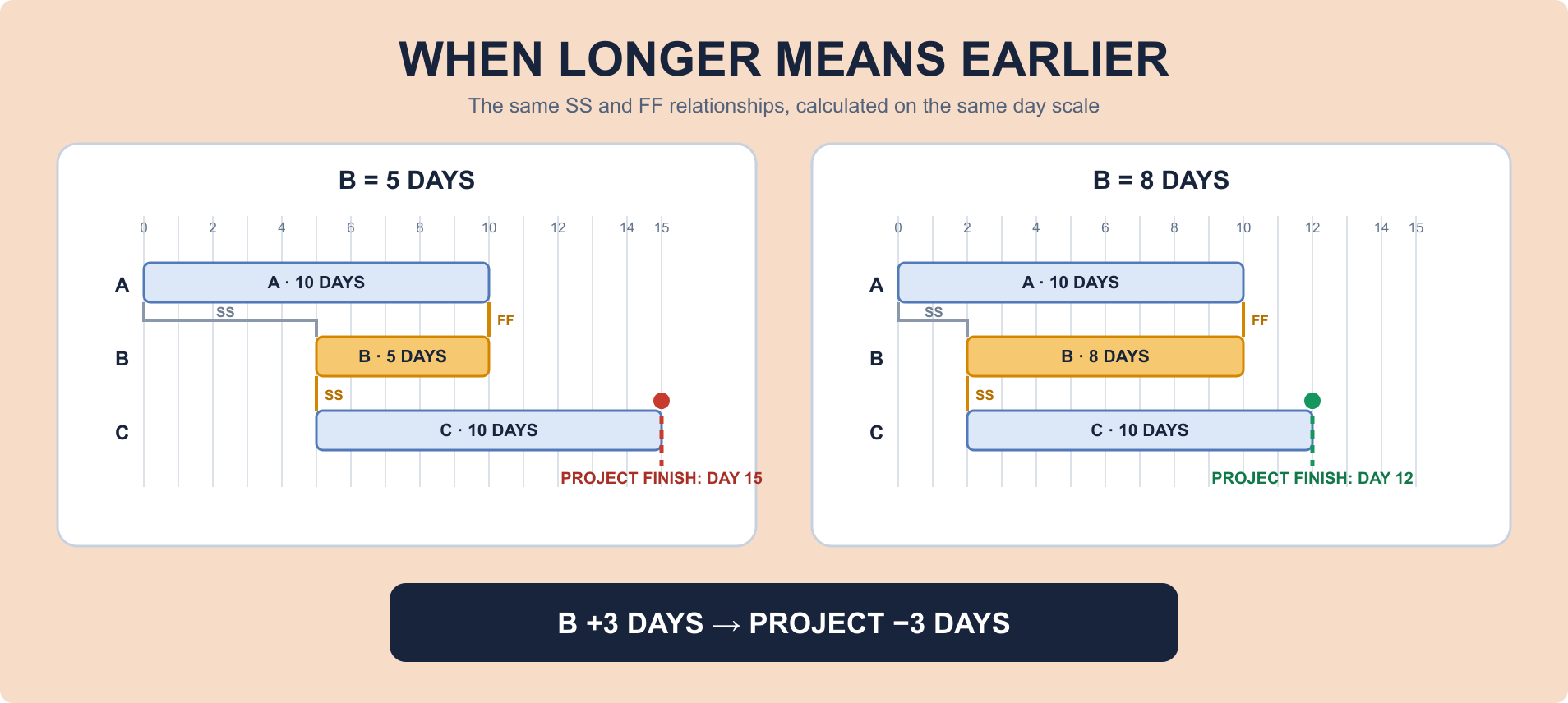
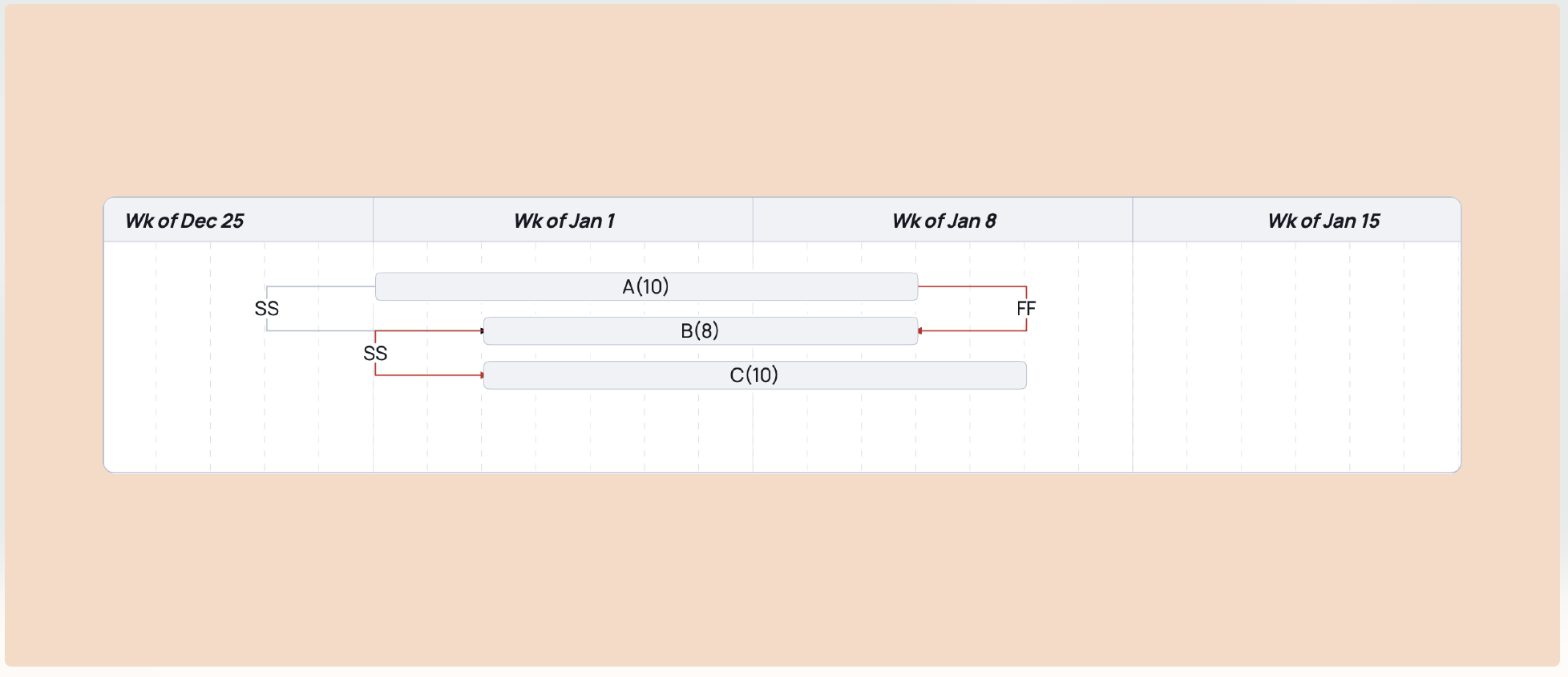
Reverse Critical Paths: Definition, Examples, and Solutions
Reverse critical paths occur when making an activity longer actually shortens your project. Learn why this happens and how to fix it.
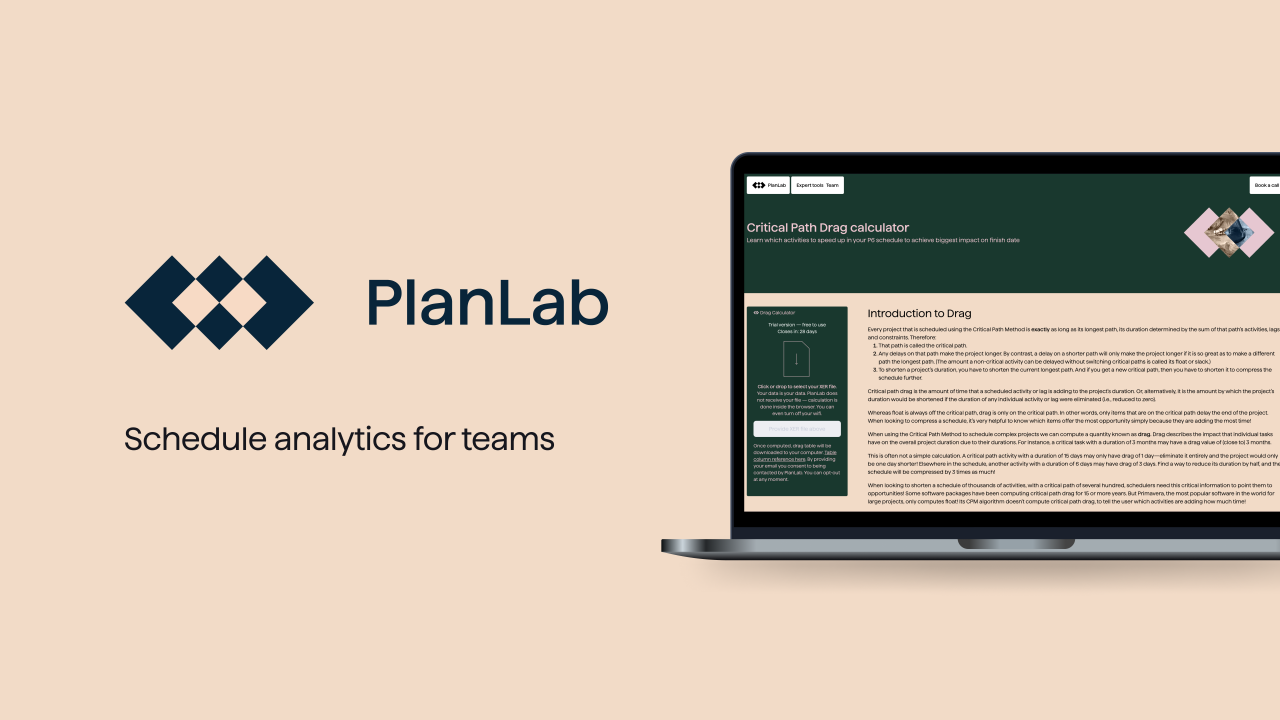
Critical Path Drag: Definition, Calculation, and Examples
Critical path drag tells you how much time each activity adds to your project duration. Learn how to calculate drag and use it to compress your schedule.