TLDR: Product Engineer (Design) at Planlab
London · Full-time · £100–160k · 0.25–0.75% share options · Visa sponsorship
- Company: We’re a seed-funded team of eight building AI software for construction and infrastructure projects. We automate our own work, including writing software with coding agents.
- Role: Make complex applications easier to use. Work with our CTO and co-founder on user flows, interaction design and visual quality. Own your work through design, implementation, testing, release and follow-up. Scope and support reflect your experience; senior hires also shape broader design direction.
- Shared tools: Build reusable components, design guidance and automated checks so the team and our coding agents can build better interfaces.
- You: A frontend engineer with strong design skills, or a technical designer who can build and ship. Earlier-career through senior applicants are welcome. Show us your judgment, initiative and clear communication through professional work, substantial projects or internships, and explain your contribution.
- How we build: React, Redux and TypeScript. We use AI coding tools for all implementation. You’ll direct the agents, review their code and check that it works. We release several times a day. Software engineering experience is a big plus.
- First 90 days: Own and ship a useful workflow improvement, contribute a reusable component or design practice, and follow up on real usage. We’ll agree the scope with you: a defined improvement with guidance through to a broader, ambiguous workflow at senior level.
- Terms: London office, some hybrid flexibility. Salary and share options reflect demonstrated skills, judgment, scope and support needed; we’ll discuss these during interviews. Options: fully diluted, four-year vest, one-year cliff. Equipment, software and AI tokens provided.
- Apply: Email jobs@planlab.ai with your portfolio, a CV or brief background, and a short note about your interest.
Referrals: get £500 by getting somebody else a job
If this job isn't the one for you, but you know someone who would be a great fit then please put them in touch with us (email to jobs@planlab.ai with them on CC). If we end up hiring your referred candidate & you were the first to intro them we'll pay you £500.
About Us
We're an AI-first company, and that starts with our own work. We automate what we can and do old-school what we must, building the tools and knowledge that teams of humans and AIs need to run construction and infrastructure projects.
Our product consists of two halves: a customer-facing platform that runs both standard and bespoke project scheduling apps, supports large-scale datasets, complex integrations and large groups of users and runs an AI copilot; and an internal AI operating system that automates and supports our own work. It dials into meetings, analyses customers' screen-shares and shared datasets, builds implementation plans, orchestrates coding agents and validation systems - and pushes PRs.
We're a small team in London (8 people), growing fast, and looking for people who see a problem and run at it - figuring things out, and not stopping at “that's not my job.” Any new joiner can make a big difference. We raised our Seed round earlier this year at a ~$25m valuation, and are now aggressively scaling the business.
Our customers are large contractors, infrastructure builders and asset owners. They build railways, highways, airports, power plants, solar farms, steel mills and more. We work with them to improve the construction schedules for these assets.
The Role
We’re looking for someone who loves product, user interfaces, and user experience. You might be a frontend engineer with strong design skills, or a technical designer who can take an idea through to working software. What matters is your ability to make complex applications feel understandable, useful, and good to use.
Our founding thesis is to automate our own work. We work through real customer problems, do what is needed to solve them, and build the systems that let us do it better next time. For this role, that means designing great experiences and turning your judgment into components, guidance, and checks that help our coding agents build more of them.
We also build software that generates and customises software. Alongside our main application, we create customer-specific interfaces and workflows using AI coding agents. We need great product design in the application itself and in the components, guidance, and testing systems that help us build more of it.
We welcome earlier-career through senior applicants with strong work to show. You’ll work with our CTO & co-founder on user flows, interaction design and visual quality. Your initial scope and the guidance and review you receive will reflect your experience; broader design direction is part of the senior scope described below.
You’ll own getting your work into customers’ hands: understanding the problem, exploring approaches, designing the experience, driving implementation with AI coding tools, and improving it after release.
You’ll also develop the shared component library, design guidance, and testing systems that help our team and coding agents produce consistent, high-quality interfaces across customer workflows.
Ownership at every level
We expect ownership at every experience level. You’ll take responsibility for getting your work to a useful outcome: understanding the problem, moving it forward, raising questions or blockers early, testing and releasing it, and checking the result. Asking for help at the right time is part of good judgment. The scope and complexity of what you own—and the support you receive—will reflect your experience.
How your scope can vary
These are examples of where you might start, with room to grow. We’ll agree your initial responsibilities with you during hiring, based on the skills and judgment you demonstrate.
- Earlier career: Own a clearly scoped improvement to a customer workflow or shared component, from understanding the problem to release and follow-up. Work with our CTO and team for guidance on design, technical decisions and review.
- Experienced: Independently own a customer workflow from research and problem definition through interaction design, implementation and follow-up.
- Senior: Own ambiguous design problems with wider consequences, shape interaction and visual direction across the product, and improve the team’s design decisions and shared practices.
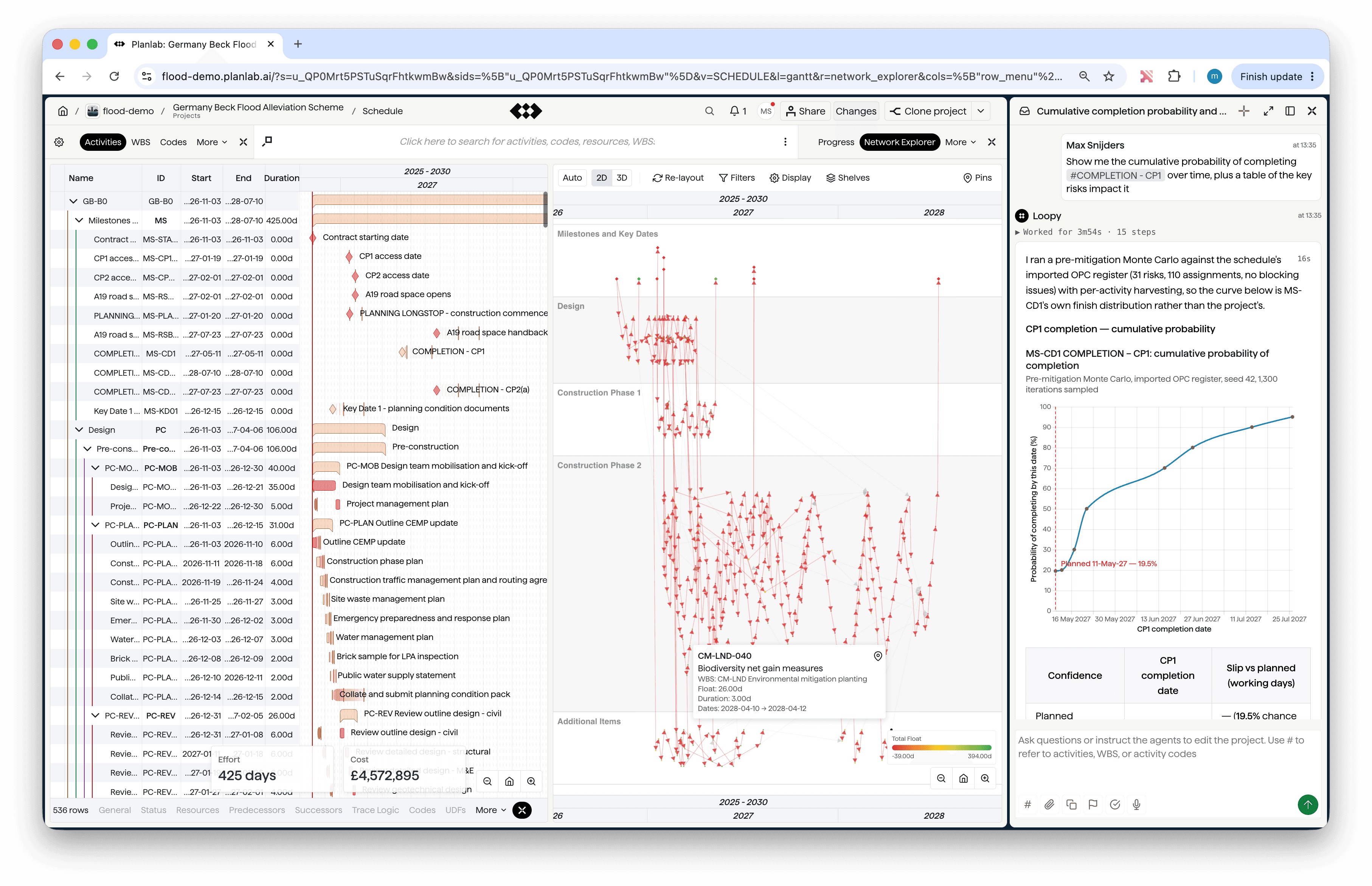
One schedule, several connected ways to understand it. Our Gantt chart, Network Explorer, and Loopy risk analysis show the depth of the product you’ll help make intuitive. Image from a demo project.
What We Offer
- Salary ranging £100k to £160k — offers reflect demonstrated skills and judgment, the scope and complexity you can own, and the support you need. We’ll discuss salary, share options and responsibilities during the interview process.
- Share options ranging from 0.25% – 0.75% (4-year vest, 1-year cliff, fully diluted)
- Nice office in London with some flexibility on hybrid
- Skilled worker visa sponsorship if needed - we’re a very international team
- Highly entrepreneurial environment
- All the equipment, software and tokens you need to do the best job
- Unlimited headroom to grow
An example: the month-end update
At month-end, a project team opens its current schedule and brings together submissions from many subcontractors. They import information from other software systems, review each submission for errors, omissions, and hidden changes, and cross-check it against the project’s wiki-style knowledge base.
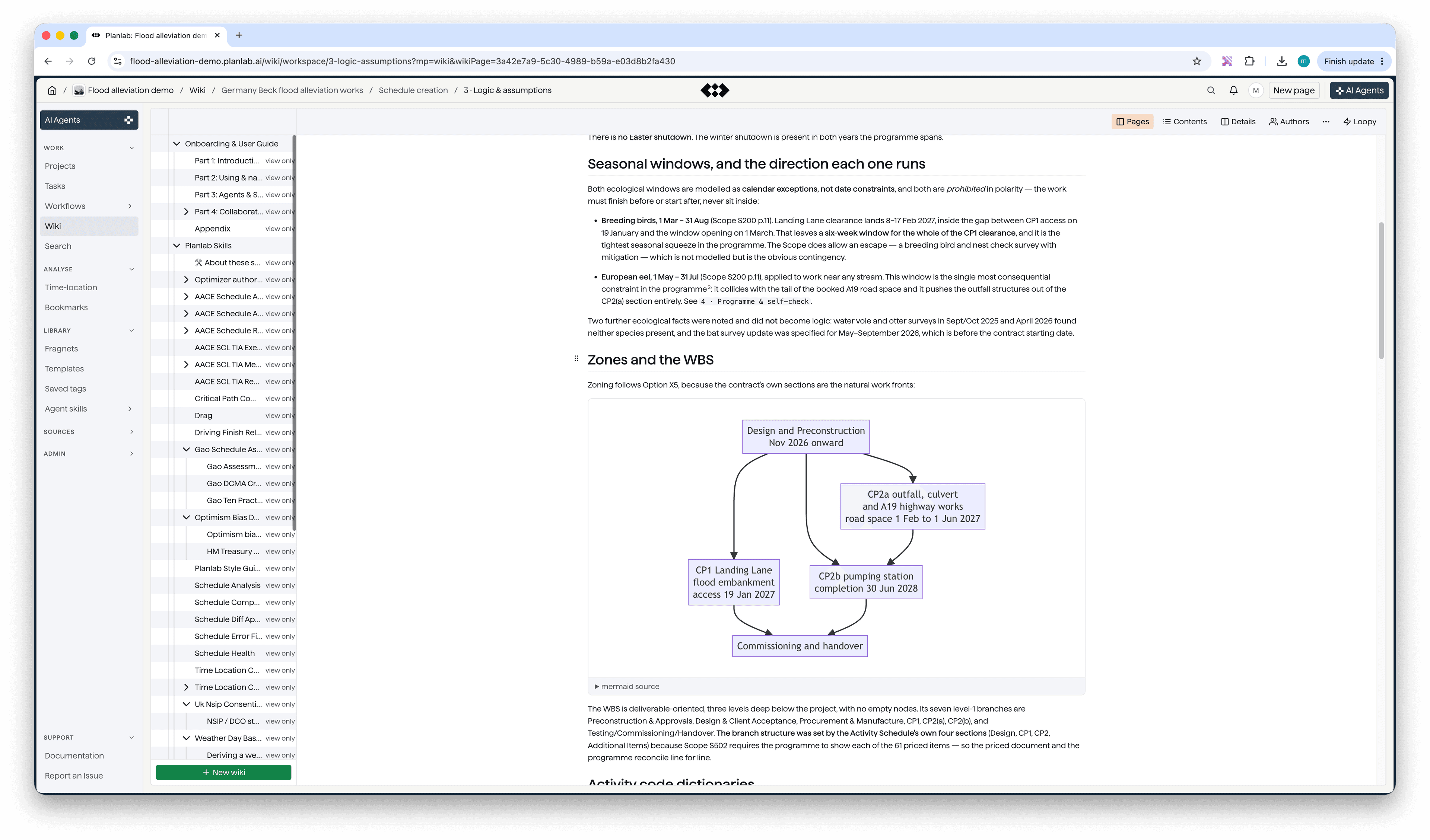
The project wiki brings guidance and supporting evidence into the workflow. Help users find the right context and understand where it comes from. Demo workspace.
They then produce a combined update and assess what changed: schedule logic, driving paths, project risk, and the impacts they need to communicate in reports.
You’ll help make that whole process coherent. How should users move between submissions, comparisons, supporting evidence, and the combined schedule? How do we surface an important change at the right moment? How do we help someone understand its consequences and produce a useful impact report?
These are the kinds of product and design problems you’ll work on, and the patterns you develop should help us solve similar problems across many customers.
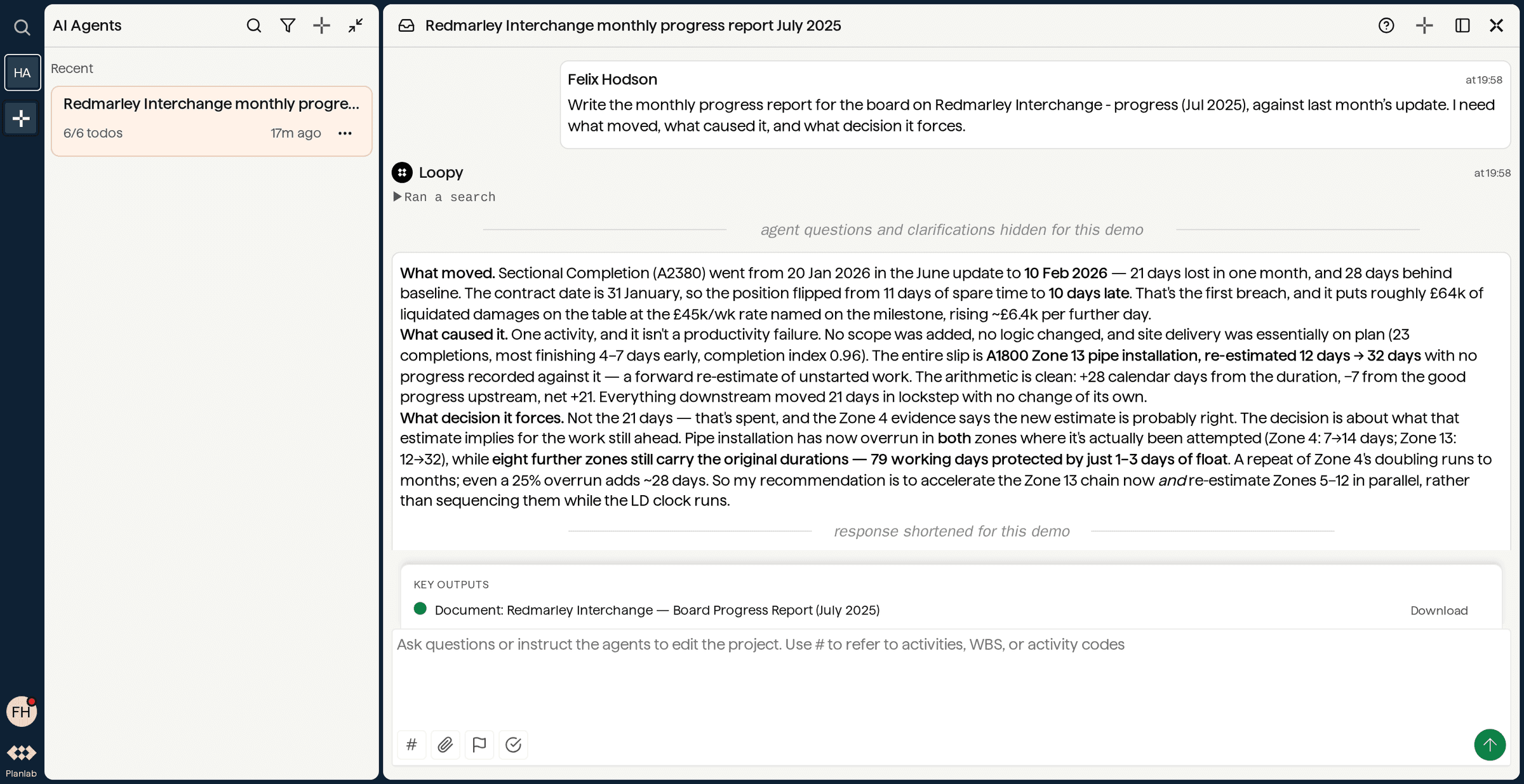
Loopy turns a request into analysis and a report. Design how users ask, clarify, review, and act on AI-generated work. This demo thread is shortened for presentation.
What you’ll do
- Design and ship interfaces for complex, data-heavy workflows, from the overall experience to individual interactions.
- Join customer sessions, work closely with our delivery team, and use product analytics to understand where people struggle and what helps.
- Own interaction design and visual quality within your agreed scope, partnering with our CTO on user flows and seeking review where needed.
- Work with delivery colleagues to understand customer needs, and with platform engineers on shared components, performance, and deeper technical changes.
- Use AI coding tools daily to drive implementation, validation, and release.
- Build reusable components, guidance, and testing systems that improve the UX of interfaces created by our team and coding agents.
- Follow your work after release, learn from real usage, and keep improving it.
What we’re looking for
Show us work you’ve designed and built, explain your contribution and decisions, and tell us what you learned from testing it. Professional work, substantial personal or university projects, and internships are all welcome. Complex applications, data-heavy interfaces and demanding user workflows are particularly relevant. Earlier-career applicants still need evidence of design ability and the technical skills to build working software.
At every experience level, you should bring:
- Strong interaction design and visual judgment, with a love of making complicated software intuitive and a willingness to learn from review.
- Clear thinking about user problems: ask useful questions, explore approaches and turn what you learn into a working experience, with guidance appropriate to the scope you’re taking on.
- Clear, structured communication: explain design decisions and trade-offs to customers and colleagues, make your assumptions explicit, and use feedback to improve the solution.
- Enough technical fluency to drive implementation using AI coding tools and take responsibility for getting it shipped.
- Initiative: you notice problems, explore solutions, and move work forward independently.
- A habit of testing your assumptions through real use and improving what you’ve built.
Previous software engineering experience is highly beneficial, particularly React or another frontend framework. We’re also open to technical designers who can demonstrate their ability to build and ship.
Technical environment
Our frontend uses React and Redux, with TypeScript throughout the stack. We use several streaming and synchronisation mechanisms to keep data and interfaces up to date as changes arrive.
We use AI coding tools for all our implementation work. You’ll direct coding agents, review what they produce, debug problems and validate the experience in the running application. You need enough technical understanding to explain and check your changes, recognise the limits of your knowledge and seek help. We expect deeper judgment about state, data flow and performance as your scope grows.
How we work
Planlab is a small team of people with high initiative. We ship continuously, with multiple releases a day. We use AI coding tools daily and expect you to drive the whole process of getting your designs into production.
We experiment, make decisions, and learn by doing. Sometimes an approach works; sometimes we discover that we got it wrong and change it. Following through, checking the result, and iterating are part of the job.
Success means customers have less difficulty using our software, enjoy working in it every day, and discover powerful functionality naturally as they need it.
Your first 90 days
You’ll get close to our users and start shipping from the outset. We’ll agree an initial scope with you and review it as you learn the product. In your first three months, we’d aim for these outcomes:
- Own an improvement to everyday work. Understand where users get stuck, ship an improvement and check the result. An earlier-career hire might own a defined part of a workflow with CTO guidance and review; an experienced hire might define and reshape a broader workflow independently.
- Give the team something reusable. Improve a shared component, design guidance or automated check and put it into use. The scope can range from one well-tested interaction pattern to a broader set of components and practices.
- Follow through and build on what you learn. Review real usage with customers and delivery colleagues, resolve issues and identify what to improve next. At senior scope, also establish a direction for a wider design problem and help the team apply it.
Success at every level means useful work in customers’ hands, evidence that it helps, and clear follow-through. The size and ambiguity of the problem—and the support needed to solve it—will differ.
Apply
Email jobs@planlab.ai with your portfolio, a CV or brief account of your background, and a short note about your interest in the role.
For the work you share, tell us what you personally designed and shipped.
Interested in this role?
Send us your CV and a short note about why you'd be a great fit.
Apply at jobs@planlab.ai